
The most expensive ERP project in my experience? The one you do twice. This happens too often when software is chosen before the problem is understood. Last year, a food company, a project manufacturer and a logistics company approached us to restart ERP after failed attempts. I cannot name them.
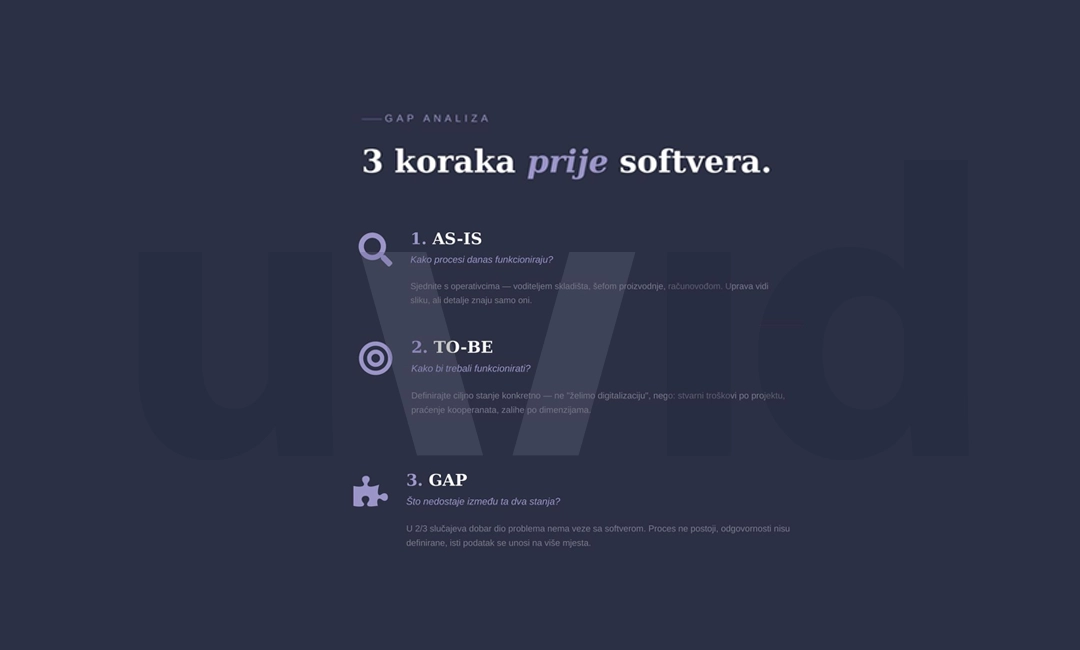
My previous post said ERP exposes chaos rather than solving it. Comments confirmed what I have seen for years: preparation is crucial. A colleague suggested consultants should organise processes before implementation. I agree. For mid-market businesses, this means a three-step gap analysis:
1. AS-IS — how do processes work today? Talk to the people doing the work: warehouse managers, production leads and accountants. Management sees the big picture; operators know the details. Purchasing may want minimum stock, but how is minimum stock defined? That is often where answers fail. Speak to both sides before documenting reality.
2. TO-BE — how should processes work? Define the target. “We want digitalisation” means little. Be specific:
• We want actual project costs;
• We need to track subcontractor work status and goods;
• We need inventory dimensions to optimise material use.
3. GAP — what separates the two? In our experience, two-thirds of cases reveal that many problems are unrelated to software: processes do not exist, responsibilities are unclear and the same data is entered repeatedly.
Only then discuss what software can solve and what requires organisational and process changes.
Without gap analysis, implementation becomes guesswork. The partner configures what they think you need, producing a technically functioning system that misses the problem. Software is hardly to blame. You paid for guessing, lost time and missed opportunities during implementation. The costliest ERP is not the six-figure one, but the one you do twice.
Marko Carević
Uvid d.o.o.