
Content author: Uvid ERP team — certified Odoo partner (ISO 9001 / ISO 27001, Bureau Veritas)
Go-live is a poor test. Everyone is alert, consultants are available and people work more carefully. Sometimes things look good because everyone is ensuring they do.
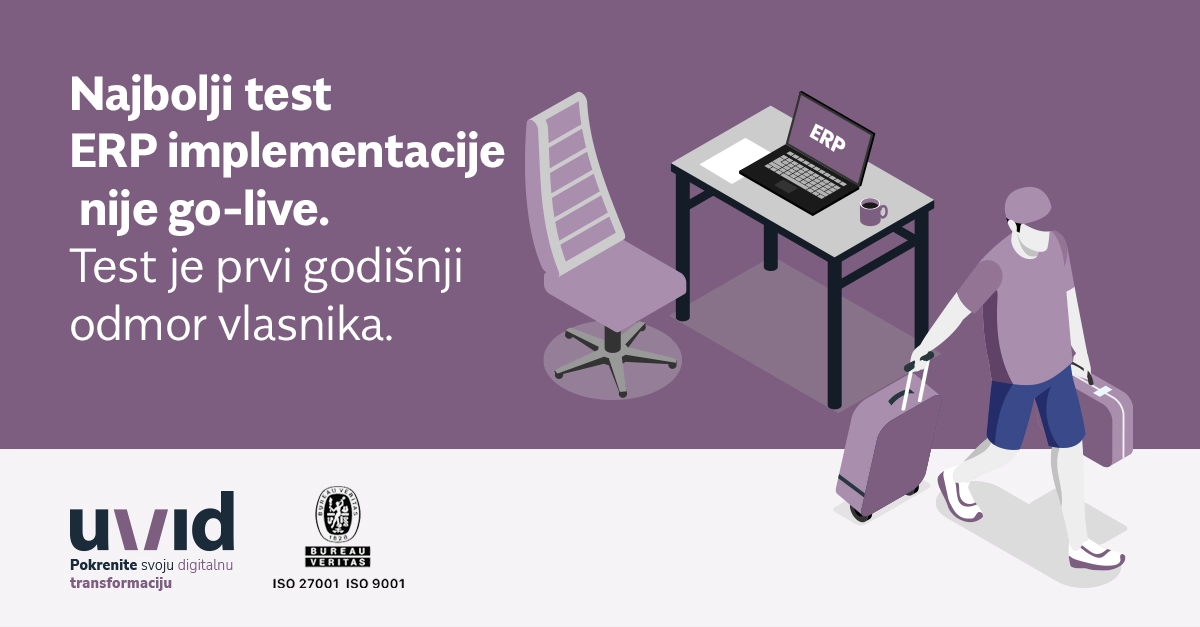
The real test comes later, unplanned: the owner or director takes two weeks off and the business relies on the system you bought.
If there are no calls, implementation succeeded. Otherwise, you know where the gaps are.
Why holidays reveal what testing misses
Every company has undocumented knowledge: who approves price exceptions, which customers pay late, why an order is handled differently and the true margin on a job.
While the owner is available, that knowledge travels by calls and messages. The system appears functional because nobody notices daily workarounds.
A holiday removes that workaround. Hidden problems become visible within days.
This tests whether operations truly moved into the system, not whether software was installed.
What to observe
The test is why people call, not simply whether they call. Examples:
|
What happened |
What it means |
|
They call for a margin, stock level or status |
The information exists but is inaccessible to the decision-maker |
|
They call for approval |
Approval rules are in your head rather than the system |
|
They call because “the system cannot do it” |
The process is not covered or was outside the project scope |
|
No calls, but work piles up for your return |
Decisions are postponed: the worst scenario because it looks successful |
|
No calls and processes continue. |
The system works |
Where data lives
Everything comes down to where data lives.
If orders, hours, project margins and delivery statuses sit in five spreadsheets and a few people’s heads, the owner is the integration layer. Unfortunately, that layer cannot take a holiday.
If data is in one place and staff see the same information as management, they can decide without you. They have the same evidence.
ERP implementation moves operations from word of mouth to an organised system, rather than merely adding modules.
Applying the test to ourselves
Uvid runs its business in the ERP we implement for clients. Our processes are documented and certified to ISO 9001 and ISO 27001, so decisions made in my absence follow the same framework I use as owner.
Internal AI tools and KPI reports use that data to speed analysis and documentation. The business works without me because data is centralised and decision responsibilities are clear; tools simply shorten the path to answers.
It is easy to sell a methodology you do not follow. Holidays test us too.
Before you leave
An honest test takes less than an hour to prepare.
Write down who decides what. Be specific: discounts, delivery confirmation and stopping work for problematic customers. If you cannot explain it in ten lines, the problem is organisational, not technical.
Check that the team sees the same numbers. Open your weekly report and ask whether a manager can access it independently. “Send it to me” reveals a gap.
Define what can wait. Some decisions genuinely need the owner. Identify them so everything else does not wait unnecessarily.
Do not write an out-of-office reply that pulls you back in. “Call me for urgent matters” cancels the test.
Record every call. That is the useful evidence. Without records, you retain only an unreliable impression after two weeks off.
If the test fails
There is no need to panic, and usually no need for new software.
Gaps typically fall into three categories:
- A process omitted from scope because it was taken for granted at workshops (scope).
- An existing report only you know how to open (access).
- A decision rule existing only in your head (organisation).
The first needs scope analysis, the second access and brief training, and the third a written organisational rule rather than an IT fix.
None requires replacing the system. All require acknowledging what you found.
A smooth test is powerful evidence of return on investment, more concrete than any pre-project calculation.
Conclusion
Digitalisation is measured by how little a business depends on one person, not module numbers.
A holiday is your cheapest diagnostic tool: around two weeks, no additional cost and an answer no presentation can provide.
Record calls if you use the test. Contact us to assess whether they indicate scope, access or organisational gaps.
If it fails in several places, perhaps take holidays more often — purely for debugging.
Uvid d.o.o. is a certified Croatian Odoo partner specialising in ERP implementation and AI agents for manufacturing, construction, trade and services. More about our methodology